Sunday, July 4, 2010

A letter from Busie

I would first like to give a big shout out to the students at Holmes Middle School in Colorado Springs for the wonderful letters and for raising money to help the orphans and vulnerable children here at Noah! I will be starting to teach English classes next month to the seventh graders and I am incredibly excited to get the learners involved in writing letters in return. I presented the Noah staff with the money and letters; they were incredibly excited and thankful.
Here is a letter that one on the learners wrote in response: (Keep in mind that her first language is isiZulu. She did a great job of writing in English.)
Dear Guyz
I’m Busisiwe and I’m 15 years old. I’m doing grade 8 at Hlakaniphini High School. My hobies are netball, balley, and tennis. My dream is to sing and I’m a song composer. I like friends and I’m a friendly pearson, kind and forgiving, I don’t like to get angry. And I live in South Africa. My country is a lovely country that you’d wish to be i
n. With a beautiful mountains we use to plant trees for carbon dioxid (freesh air) everything that you’d like you can find it in. My country, they are different people. So as Erin told me about you country and I’m telling you about mine. I’d always want to visit your country everyday when I’m imagining myself. I always imagining myself in your country and trust me you don’t want to know.
Love: Busie

The month of June was incredibly busy for me. I helped to put on a holiday program for the children in the community. Being that the children are on winter holiday we wanted to have a camp for the kids to keep them busy and out of trouble. We did not have much time to prepare, but in the end the kids seemed to really enjoy themselves. I would also like to thank Mrs. Sobeck for the donation of the soccer balls. I received them just in time for the camp. The kids were so excited to have balls to play with.
Highlight:
I have a new friend and possible isiZulu tutor! One of the kids at the camp came up to me and began talking to me. She began to really take a liking to me within a couple days. She even invited me to go see her house and meet her family. Yesterday, she came to pick me up and we walked the fifteen minutes to her house. She showed me her house, I met some of her family, she taught me how to play a couple traditional games, and we ate oranges from the orange tree in the yard. It made for a great Saturday afternoon. I also asked if she would be willing to teach me isiZulu. I feel that there is a lot that we can learn from one another.
This weeks Pictures: The first picture is of Busie, the learner that wrote the letter. The next picture is of Mxolisi and I balancing on a tire. The third picture is of one of my favorite little friends, Yolanda, as she posed for a picture outside the school building.

Monday, June 14, 2010

World Cup Fever

Have I mentioned that I enjoy receiving mail? Well I do! I only get into town every couple of weeks and my first stop is always the post office. The post office sits of the top of a very steep hill, tucked right in between the police station and the local jail. There are usually men in orange uniforms cleaning the premises while the guard sits off to the side half asleep. The taxi stops at the bottom of the hill. So, I make my way out of the taxi, climb the hill, avoid the random men in orange suits, walk up the five steps to the post office and my P.O. Box is the one on the lower left hand corner right before entering the post office. I put my key in, turn and yank. The door to my box is jammed so I always have to yank pretty hard to open it. After retrieving my mail I walk down the hill across the street, down another hill to my favorite little coffee shop. I try to treat myself to a coffee when I am in town. It’s the only decent cup of coffee I can get for weeks, and the coffee shop also has an amazing view of the Indian Ocean. That is a little slice of heaven right there, coffee, mail, and a beautiful ocean view.

I am sure you are wondering how the little puppy, Spot, is doing. Well, I am happy to say that he is much healthier. He is still not completely well; I have noticed these past couple days that he is looking quite skinny. In fact, I can count his ribs. I know they are feeding him so I am not quite sure what the problem is. The dog has a name now, her name is Speedy. Don’t ask me why, because she is definitely not speedy. She is still in that clumsy phase where, when she is running her front legs will give out and she does a nose dive into the ground. It’s actually quite cute to watch. Another part of having this puppy is trying to teach the girls how to treat a dog. Here, in South Africa, dogs are not seen as pets, like in the US, they are more just used as guard dogs. Most people are very scared of dogs here. The dogs are treated very poorly; they are kicked around and abused. I am using this puppy as a teaching mechanism. I am trying to show them that a dog can be trained and polite while still being an excellent guard dog. I am teaching the girls (my two nieces) how to play with a puppy. I think sometimes they just think I am a crazy American. Can anyone tell me what kind of dog Speedy is?

Yes, the World Cup is here! And I can feel it! Everybody seems to have come down with the World Cup fever. Excitement is runny high and everywhere you turn there is a South African flag. Unfortunately, I do not have tickets to any of the games. The closest stadium to me is in Durban, which is just about an hour south of here. All schools are closed for this month in order to “cut down” on the traffic. The South African team is the Bafana Bafana. Here is a picture of some of the students at school with World Cup fever.

On Sunday, I went with my host family to an umkhehlo. I am still not quite sure what the significance of an umkhehlo is but it involves the families of both fiancés and a lot of dancing. It started out with the young women running around yelling, dancing, and singing. They then presented the bride with cow fat. Yes, cow fat! The fat was washed and dried and then draped over the bride’s shoulders which she then wore for the remainder of the ceremony. As I talked about earlier, the men and women are always separated at events. The women sat under the shade trees while the men sat off in the bushes drinking their traditional beer. After the women danced and sang for about an hour, the men all got up and marched over. Then for the next two hours it looked like a game of pass the stick. The bride and her bridesmaids would dance over to the men and put sticks in the ground in front of them, they would then turn around and dance back. After a couple minutes a few of the men (never the groom) would get up and walk the sticks back to the women’s side. This went on for a good two hours. Occasionally, one of the men would get up, yell something and all the other men would respond. And then my favorite was when one of the Gogos (grandmothers) would get up randomly and dance around and yell. I have videos of the event but unfortunately I can’t upload them. Here is a picture of one of the men in traditional Zulu attire. He also proclaimed his love to me and told me he wanted to marry me (this is pretty common), but he then told me that he is from a polygamist family so he wants multiple wives. I told him that that wouldn’t work for me. The picture was taken by his sister whom had never used a camera before, hence the diagonal portrait.

Sunday, May 23, 2010

Grandpa is Dancing Again

Firstly, I must apologize for the delay in posting, it is partly due to extenuating circumstances and partly due to my lack of words. I am finding it difficult to put my thoughts and experiences into words. Some of my fellow Peace Corps volunteers have started using their blogs as more of a journal, they write about the positive aspects of everyday. Life is not easy here; poverty, crime, illness, death, and racism are just a few of the battles that these people face on a daily basis. As a PCV, I witness this daily, it can quickly wear a person down. In every social work class I had, they emphasized the point that you must first help yourself before you can help others. There are little things that I do on a daily basis to keep a positive mind. Every morning, I wake up with the sun, I take a minute to enjoy the beauty of this world that I am living. As the sun begins to shine in my hut, I bask in the warmth of the light as I drink tea. This sets a positive mind set for the day. At the end of the day, once the sun has disappeared and I have said my good nights, I take a moment to remember all the positive aspects of the day. Here are just a few of the positive moments:

Saturday, May 15, 2010
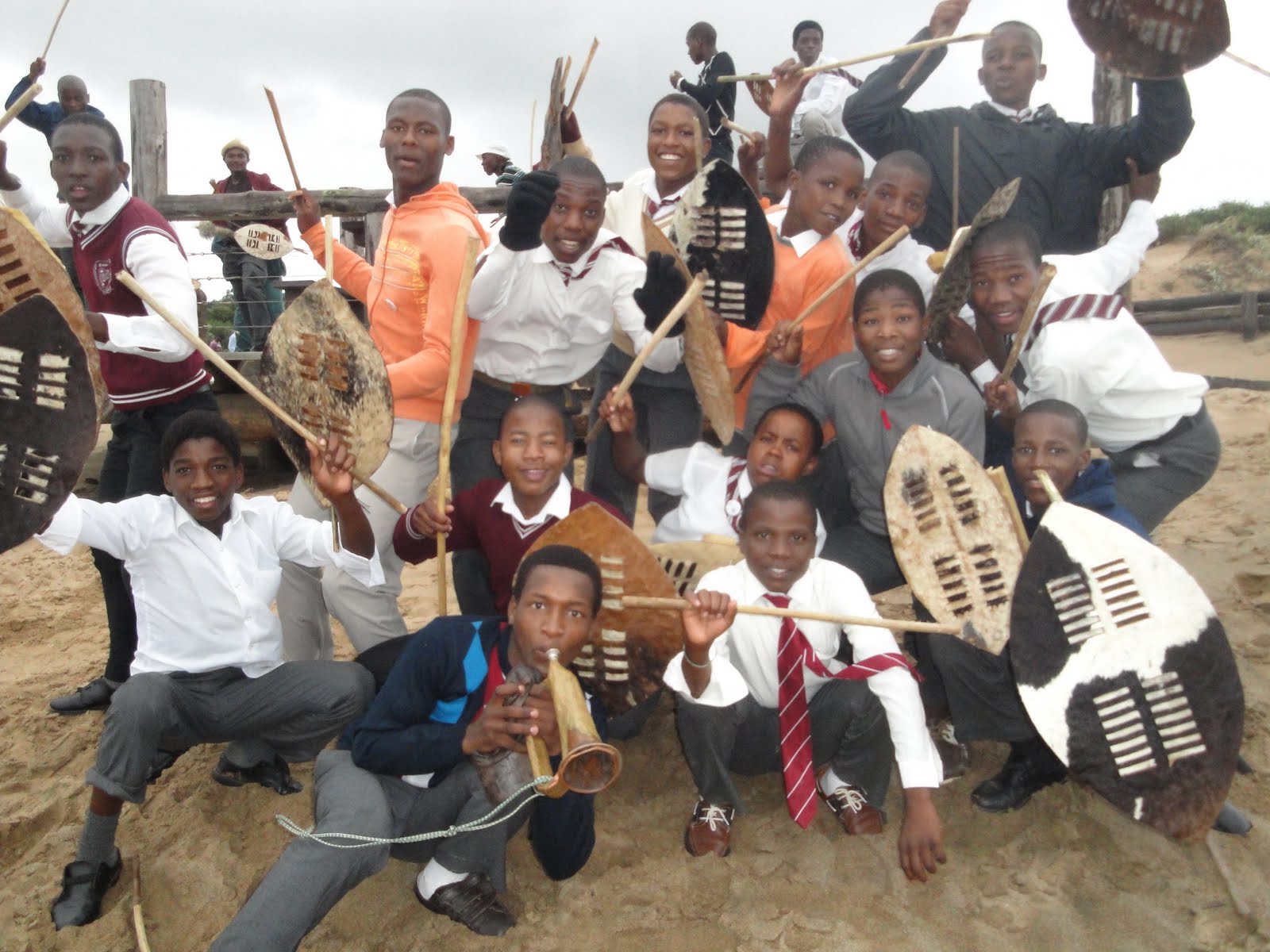
Today was a great day, Lindsay, my nearest PC friend invited me to go to a cultural dance competition. The setting: the beach! I woke up this morning to find it overcast, cold, and rainy. I thought there was no way I was going to go. I would have to stand out in the rain for an hour or more to try and catch a taxi into town. But to my surprise, they (Lindsay and her coworker)offered to come pick me up! As we pulled up to the event there were groups of excited kids all around dressed in their school uniforms. We were told the competition was to start at 9am...(I frequently forget that everything runs on African time here) two hours later the students are all dressed in their traditional attire anxiously awaiting their time to shine. It was truly an incredible experience to watch these kids, dressed in tradition attire, perform these dances that have been passed down through the generations.

Wednesday, May 19, 2010
The grade R learners (students) have taking a liking to me. Grade R (R stands for readiness) is equivalent to kindergarten. After a couple cups of tea this morning my bladder was about to burst. As I rushed out of the office and down the stairs I was swarmed by the grade R learners. They all wanted to hug their new friend Nokuthula. They yell in the only English they know, "Hi Nokuthula, how are you?" By this point I can't move, I am five kids deep on every side. The teacher stands back and laughs as I struggle to free myself. I finally break free and run off with kids trailing behind, I yell back "Ngiyabuya, Ngiyabuya! (I am coming back!)" in a failed attempt to not have the entire class follow me to the pit toilet.

Saturday, May 22, 2010
Today I went to a graduation party with my host mom. I had never actually met the graduate before the party but she was the former manager of Noah, she quit shortly before I arrived to go back to school to get a teaching degree. As with most things, when my mom and I arrived at the party, everyone was surprised to see a white person in their midst. After many hugs from excited Gogos (grandmas/old women) I was offered a seat. One thing I have learned here is that it's not a celebration without song and dance, but not the song and dance you would see in the US. To try and paint a picture in your mind: at functions the men and women typically sit separately. The old men sit on stumps under trees drinking traditional beer while the women sit else where. They all have this withered look about them from years of hardship. The old men all have their walking stick and the gogos walk with great care. The ceremony was set to start at 2pm, so at half past four the graduate made her appearance dressed in her cap and gown. The music began, the Gogos and Grandpas jumped to their feet and began to dance around, yelling and rejoicing. It is truly a site to see.

This weeks pictures: the first two pictures are from the dance competition. The third picture is of a group of the learners at the school. And this last picture is of a zebra that I saw just hanging out in my shopping town.

Friday, May 7, 2010

Umlungu

I am called by many names here in my rural South African village. The first of which and the most common is Nokuthula. The first night I moved in with my host family in Mpumalanga they gave me the African name, Nokuthula, meaning “quiet and peaceful one” (I would say it’s a fitting name for me). Now that I have moved into my new village I now have a second name. That name is Umlungu, meaning “white person.” For anyone that does not know me by Nokuthula they just simply call me Umlungu. When riding in the local taxis I often here people whispering to each other “who is this umlungu (in Zulu of course)?” thinking that I don’t understand. The best part is when I turn around and greet them in isiZulu. All the looks of skepticism and judgment melt away as they realize that I can speak their language. I then explain in my broken isiZulu that I am from the US and that I volunteer and live in the village. They then greet me with open arms.

I guess I have never really experience truly being a minority before. It is not easy being the odd one out. I often feel part of a game, “Spot the Umlungu.” No matter where I go people point and yell “Umlungu” as though they have just won the prize for finding the umlungu. I also explain it as walking around with a spot light over me. I am always drawing attention and stares. Sometimes I think that if I am far enough away or if it is dark enough people won’t be able to tell that I am an umlungu, unfortunately it does not work that way. I am sure as time goes on I will just be yesterday news, but for right now I am the talk of the town. In fact, if my village had their version of the Enquirer I would make the front page.
The headlines for this week’s Enquirer: “Umlungu deathly ill after walking for hours,”
“Rich American Saves African Family from Bankruptcy,” and “Umlungu Kicks Families out
of Houses.”

Random Thoughts:
I recently learned that I share a birthday with South Africa’s greatest leader, Nelson Mandela. I am very excited about this recent discovery. A few months back during training we took a fieldtrip to the Nelson Mandela Museum in Johannesburg. Here are some quotes from Mandela:

“I learned that courage was not the absence of fear, but the triumph over it. The brave man
is not he who does not feel afraid, but he who conquers that fear.”
“There can be no keener revelation of a society's soul than the way in which it treats its
children.”
“And as we let our own light shine, we unconsciously give other people permission to do the same.”

My host father acquired a puppy! It was given to him by a friend. They (my host family) were talking about getting a puppy since Tsotsi is an older dog. The bad part is that the puppy, which I am here by naming Spot, is a very sick little guy. But my host father being the animal lover he is, is nursing Spot back to health.

This weeks pictures: The first picture is of Wandile and me, she is my little two year old niece. The second picture is some of the children at work standing in front of the NOAH sigh. And then there is the picture of Spot.

Sunday, April 25, 2010

A day in my sandals

Before becoming a volunteer one of my biggest questions was what does a day in the life of a volunteer look like. Fortunately for you, I am going to give you an insider’s view into the not so glorious life of a volunteer.

12am – Wake up to raindrops on my head. My rondaval has 15+ leaks in the roof so when it rains outside it also rains inside. Get up, put a towel over me and go back to sleep.

2:30am – Tsotsi (my guard dog) has vocal lessons outside my window. I have decided that he enjoys just listening to himself bark.

4am – The roosters begin to crow

5:30am – The birds begin to gather on my roof

6am- My alarm goes off, hit snooze a couple times before I manage to roll out of bed

6:15-6:48am – Get dressed, eat breakfast, check my email and prepare my bag for the day.

6:48 am – Leave for work/school. Greet every single person I pass along the way.

6:56 am – Arrive at work/school. Greet all my co workers.

7:05am – Morning song and prayer. Every day begins and ends with a song and prayer. Meetings also begin and end with a prayer. This is customary even for nonreligious organizations.

7:15am – Begin cleaning up after our nightly visitors, the bats. They are very good about letting us know that they were there.

7:30am – Children begin to arrive to school. Greet and play with the children.

8am – School begins. I enter data into the computer or sit in the kitchen and watch the cooks prepare the days lunch.

10am – Tea Time!

10:30am – Join one of the Red Cross volunteers to teach a class on HIV, drugs, rape, etc.

12pm – The kindergarteners get out of school. Serve them lunch

12:30pm – Eat lunch (will post a menu later)

1pm – The 1st graders get out of school. Serve them lunch.

2pm – Serve all the learners (students) lunch

2:30pm – Study isiZulu, do computer work, play with kids, try to keep myself occupied, etc.

4pm – Closing song and prayer

4:05 – 4:20 – Walk home with co workers. Notice time difference in walking to work and walking home. I have not completely mastered the art of the slow walk but I am forced to learn as I meander home with my co workers.

4:20pm – Arrive home. Greeted by my nieces (ages 2 & 6) and Tsotsi

4:20 – 5:45pm – Bathe and play with nieces until the sun goes down.

6pm – Retire to my room for the night. Eat dinner, read, watch a movie, journal, and keep myself occupied

9pm- Lay in bed, count all the springs in my mattress. Eventually fall asleep.

As I have probably mentioned before, the first three months at site are the observation period. Thus, I don't do too much. I am sure this will change once I begin working on projects.

Saturday, April 17, 2010

Nurturing Orphans of AIDS for Humanity


I have neglected to tell you what my main job is here in South Africa. I am working for an organization called NOAH which stands for Nurturing Orphans of AIDS for Humanity. NOAH provides services to orphans and vulnerable children (OVCs). It was started in 2002 and there are now 101 NOAH (Arks) locations throughout KwaZulu-Natal and Gauteng provinces. Statistics say that an average of 1 in 3 people in South Africa has HIV/AIDS. There are approximately 2.5 million orphans and many more vulnerable children and about half of those orphans are due to the AIDS pandemic.
I am working with one of the Arks in a rural village in KwaZulu-Natal. We are based out of a local primary school. We are currently serving 276 OVCs in a school of about 500 students (grades K-7). And there are many more students who would greatly benefit from our services. The biggest service we provide is our meal program. We serve approximately 260 hot meals a day. For many of the children this is the only meal they will get the whole day. We also provide after school activities, bereavement counseling, daycare, HIV/AIDS education, and life skills classes.
So where do I fit into this? These first three months at site are called Community Integration (or as volunteers refer to it as "Lock Down"). I am learning about the organization and figuring out where I will fit in and what I can offer. I am also to use these first months to continue learning the language and to perform a Needs Assessment on the community. There are a lot of great opportunities here for me and I can't wait to begin!

I smell!!

So apparently, I have forgotten how to take a bucket bath. The first two months I was in South Africa I was living in a house that did not have running water. We fetched the water from a tap in the yard; however, the water to the community was shut off a good portion of the time. This required a lot of water conservation. When the community water supply was turned on, it was a mad dash to get all the buckets you owned filled with water because it was unknown how long the water was going to be on and how long it would be before it was turned back on. On average, the water was off for a couple days and came back on for only half a day. It got worse as time went on. At points, the water was off for a week at a time and it was turned on for a couple hours in the early morning around 3am. It got to the point of desperation for water sometimes that when the water came on in the early morning hours everyone was awake and scrambling to store as much water as possible. The moral to this story is that I learned very quickly how to survive on very little water. Here are a few water conservation tips:

  • Flush toilets use a great deal of water and are a luxury in most houses. Build yourself a pit latrine in the yard. No water required just a little bug spray to keep the insects at bay. Side note: The one down side to using a pit latrine is that once about 8pm hits the house is locked up and you are not allowed to leave until morning. Thus, you must have a pee bucket for use at night. Now, even though everyone uses a pee bucket, it is important that in the morning you empty it in secret. This is where the bucket bath comes in handy (see bullet point 4).
  • When doing dishes just use a single bucket. Fill the bucket with hot soapy water. No rinsing required, just dry the dishes and put them back. Side note: use the same dish water all day, no need to change the water even once it becomes brown and murky.
  • Do laundry by hand. Use two buckets, one with soapy water to wash and the other for rinsing. Important tip: always remember to start with your whites and lights and wash those first. The water turns brown pretty quickly, so to insure that your whites stay whitish always begin with those (lesson learned the hard way, I now have a selection of brown underwear). And just like with the dish water, no need to change the water once it becomes brown and murky, after all, it is just dirt.
  • And lastly, take a bucket bath. Who really needs a shower when you can take a bucket bath? All you need is a bucket (big enough to stand in), a cup for pouring, water and soup. With only two liters of water you can wash your entire body. Now, since bathrooms are a luxury, bathing is done in the bedroom, therefore it is important to keep the splashing under control. Always remember to start with your face and hair and then work down from there. A bucket bath spreads the dirt evenly throughout your body and leaves you smelling fresh and clean because you are unable to completely rinse all the soap from your body.
    • As I mentioned above, the dirty water after bathing can also be used to inconspicuously dispose of your pee bucket. Just keep the dirty bath water until morning and pour them out together, just make sure to rinse the bucket before using it again.

Now back to my main point. I have been at my permanent site now for a little under a month. I am spoiled here. Even though I do not have running water in my rondaval, the family’s house has all the western conveniences, a bathroom with a toilet AND shower along with a fully functioning kitchen sink. However, the problem lies within the last couple of days. I have been so spoiled with my daily showers that I have forgotten how to take a bucket bath. Just as I was beginning to take water for granted, the water to the community has been turned off. This means I have to resort back to the days of bucket baths. With this being said, water has become scarce and it’s back to the world of water conservation and I must resort back to the old way of life.

 
Copyright © 2009 Nokuthula All rights reserved. Powered by Blogger
Blogger Template by Anshul